Background
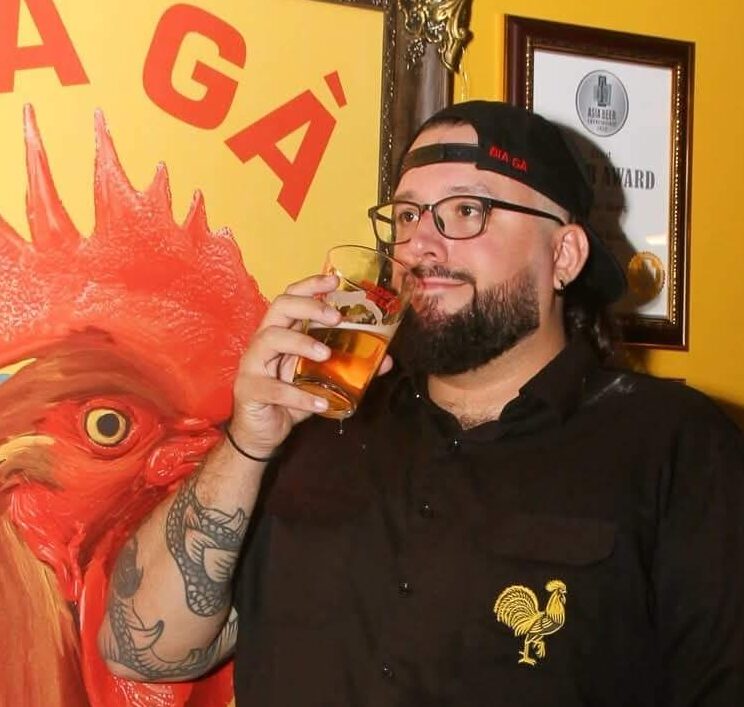
My name is Don Viteri, originally from Chicago. Before Vietnam, I spent seven years in professional kitchens, working my way from line cook to head chef. I was also a drummer in a few heavy metal bands back home, still jam when I get the chance. In November 2016, a friend invited me to Ho Chi Minh City to help run a restaurant/bar. I landed with $75 to my name and nothing to fall back on if it didn’t work out. That leap eventually led me to Rooster Beers, part of Vietnam’s first wave of craft breweries, founded in 2015 by Michael Sakkers, now one of my closest friends here.
I started at the ground level and worked my way through nearly every role in the company: sales, marketing, commercial leadership, CEO, and now COO. Nine years in, I’ve had a hand in nearly every part of building Rooster from 4 beers and a handful of accounts into what it is today. Mike’s actually taken to introducing me as his “honorable mention co-founder” at events and to guests, since, in his words, I helped him build this company from the ground up. Over the years that’s turned into real sweat equity too, I’m a small shareholder in the business today.
Why This City
I was invited out to Ho Chi Minh City by a mutual friend of mine and Mike’s, and landed here in November 2016. I was originally brought on to help create, run, and manage a bar serving western food. It’s funny looking back now, Vietnam was the first country I’d ever been to outside the US, which meant I had zero read on the market, or even what the market was. So it’s no surprise Mike’s wife, Mai, quickly changed the concept.
While I was managing the bar, Mike started teaching me the technician side of things: pouring equipment, troubleshooting equipment issues, the back-of-house for Rooster Beers, which he’d founded in May 2015 out of a small brewery in Can Gio, about 1.5 hours by bike from District 1.
That’s when it clicked for me. I wasn’t just managing a bar anymore, I was learning how to build something from the ground up in a market that had barely seen craft beer before. I stuck around, kept learning every piece of the operation, and never really left.
The Idea
In 2015, there were already a handful of craft breweries around town. Mike met Tim and Mark from Quan Ut Ut (BiaCraft), they got to talking, and not long after he was selling Rooster Beers into Quan Ut Ut, Sancho’s, and a few other venues around the city.
His idea was simple: make beer that tasted better than the local lagers and could stand up to the Saigon heat, without the pretentiousness a lot of Western craft breweries were leaning into at the time. He wasn’t building for beer snobs, he was building for drinkability. The goal was always 10 Roosters in a session, not one you sip and set down. That’s what set Rooster apart in the scene back then, and it still does.
I wasn’t in the room for that original bet, I didn’t land in Vietnam until the following year, but it’s the exact principle I’ve carried forward as we’ve grown: keep the beer approachable, keep the price low enough that it’s not just for expats and tourists, and go where the drinkers actually are instead of chasing the upmarket crowd.
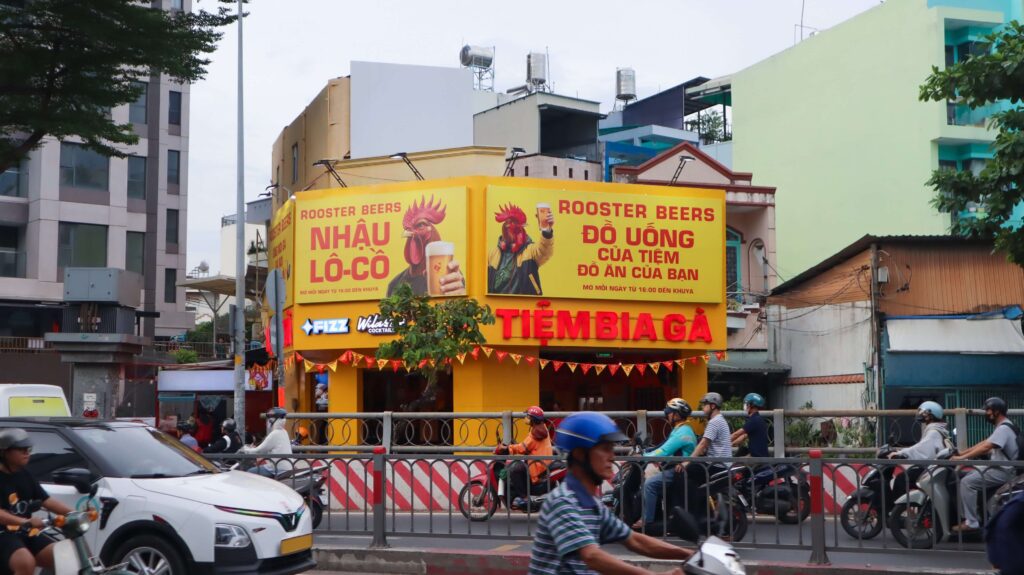
Oh man, yeah, there’s always missteps and decisions you wish you’d never made when you’re running a business, and if someone tells you they’ve never had one, I don’t trust them. One of the first Tiệm Bia Gà taprooms we opened was on a busy, well-lit street that checked every box on paper. What we didn’t account for was the impact of being on a one-way street. When we surveyed customers who actually sat down at that location, most said if they drove past it, they weren’t willing to loop back around to the light and do a U-turn just to come in. We tried everything, brighter signage, you name it, but it never worked out. We closed it down after 8 months.
Getting Started
I wasn’t around for the exact figures on this one, so take it as broad strokes rather than a line-item budget. Mike started with a 150-liter brew kit, and from there, every dollar the business made went straight back into equipment, a cold room, kegs, whatever the operation needed next.
All together it was about $1,000 on everything to get started back in 2015, it was a small system, so breakeven landed somewhere around 3-4 months, maybe less.
Building anything from scratch in Vietnam back then was its own education. There’s this incredible resourcefulness here, if you need something built, you find a welder, a farmer, a fabricator, whoever, usually by word of mouth or just riding around and asking. Bring a good Vietnamese friend who can translate and you’re most of the way there. That’s how Mike ran it early on: DIY, bootstrapped, proving the beer worked in a tiny market of friends’ venues and Mai’s place before scaling up.
Licenses and permits are their own beast here. The process is genuinely complicated and changes depending on what you’re doing and which province you’re working out of. There’s no one-size-fits-all version of it.
Once Mike had some traction, two friends invested, and later a bigger investor came in who’s still part of the business today. That backing is what let him grow production and expand distribution. Mike’s wife, Mai, is Vietnamese, and being married to her helped navigate some of the licensing, though people probably overestimate how much of a shortcut that actually is.
That’s roughly when I came into the picture and started working alongside Mike and Mai myself.
The First Six Months
My first six months weren’t Rooster’s day one, that was Mike and Mai’s chapter back in 2015. Mine started when I landed in November 2016, and Mike began teaching me the technician side: pouring equipment, kegging, all the back-of-house work that actually keeps a brewery running.
I was not mechanically inclined at all (a bit more these days), so learning how to properly use tools and troubleshoot equipment was a real challenge early on. I remember one specific time I forgot to add a single hose clamp, and the line blew off, beer went everywhere. I scrambled to figure out what happened while Mike had a good laugh watching me lose my mind. Then it clicked: I disengaged the coupler, pulled the bottom panel off the draft machine, found the hose I’d connected without a clamp, and cursed myself out for such a dumb mistake. There were plenty more “dang it” moments like that, but I picked it up fast because I had a good teacher. When it came to sourcing materials, cleaning supplies, install parts, whatever we needed to diagnose a problem, we’d hop on scooters and Mike would show me the local shops he used. Eventually they knew me by face after enough visits. Managing the bar alongside the early Rooster tech work wasn’t too bad at that stage, we just didn’t have that many customers yet.
Back then it was Mike, Mai, myself, a delivery driver, and a handful of brew staff. I’m actually one of only three people still with the company from those days. Funny story on how I ended up in sales: Mike and Mai overheard me at the bar one day, walking a customer through our most expensive menu item before heading back to ring it in. Mike asked if I wanted to try sales. I said, “nah man, I’m not good at sales.” He laughed and said, “what are you talking about, I just watched you sell a whole story around pork ribs to that guy, that was sales.” I hadn’t thought of it that way, but I said sure, I’d give it a shot, no promises. Fast forward a bit: I ended up with 65 accounts citywide as a rep, which was solid for a young, up-and-coming company at the time.
What actually surprised me was how early-stage the craft beer scene here still was. I came from Chicago, where I was already deep into craft beer, so in a weird way I felt more equipped walking into Vietnam’s beer scene than most people would coming from a kitchen background. Vietnam was still in its infancy with craft beer, and that gap between what I already knew and what the market hadn’t caught up to yet is what made it click so fast for me.
Looking back, that period was less “running a company” and more learning everything from scratch while it was already moving. I didn’t realize it at the time, but Mike was quietly shaping me up to help him run the day-to-day with him.
The Business Today
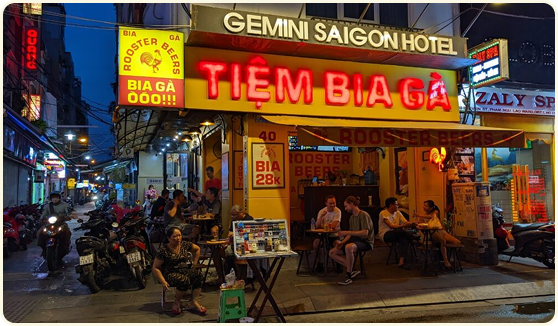
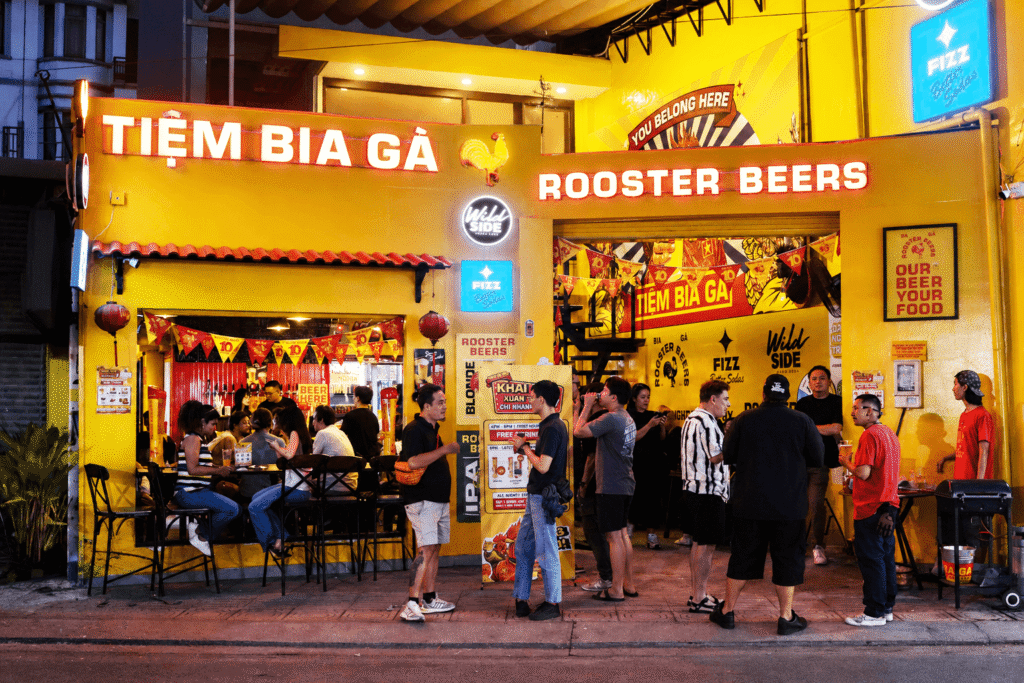
We’re in 200+ locations across draft and cans, plus 7 taprooms under the name Tiệm Bia Gà, TBG for short.
I can’t share the exact numbers for revenue, but I can tell you almost all of it goes straight back into the business, new taprooms, equipment, and growing the team. We’re not sitting on distributions at this stage. Margins are intentionally tighter than most craft operations. That’s the tradeoff for keeping beer priced where regular people can actually afford to drink it often, instead of chasing bigger margins on a smaller, higher-spending crowd. Our model is built around volume over margin per pour. We want people ordering rounds, not nursing one beer all night.
We’re producing around 3,310 hectolitres a year now, 2025 was actually our best year to date. Headcount-wise, we’ve grown from about 10 staff, including upper management, back in 2016, to 56 today.
The trajectory’s been a bit of a rollercoaster. In 2016 we were doing around 1,000 hectolitres, and we grew steadily from there, roughly 1,500 in 2017, 2,000 in 2018, and about 2,550 by 2019.
Then Covid hit us in two waves: 2020 dropped to around 2,140 hectolitres, and 2021 was worse, down to about 1,440, as things really shut down.
2022 came back hard though, we more than doubled to around 3,230 hectolitres as post-lockdown spending picked back up. 2023 and 2024 were pretty flat, sitting around 3,000 and 3,050. And 2025 was our best year yet at 3,310.
This year’s looking good too, we’re already about 70% of the way to our 2026 target, though I’ll keep the actual number to myself, I’m a little superstitious about jinxing it.
Customers
Our customer base is overwhelmingly Vietnamese, not expats or tourists. Most of our content and messaging is in Vietnamese with little to no English, and that’s intentional, we built this brand to fit into people’s regular routine here, not to cater to the foreigner crowd chasing a “craft beer experience.” Rooster’s approachable by design, in the branding and in the beer itself. We want you drinking 10 beers in a session, not one and done.
That wasn’t always the case operationally, though. In the early days we didn’t have a single taproom, just Mai’s bar that I was managing, called The Chicken Coop. Whatever customer base we had back then came from relentless cold calls and networking, going out and building relationships one account at a time.
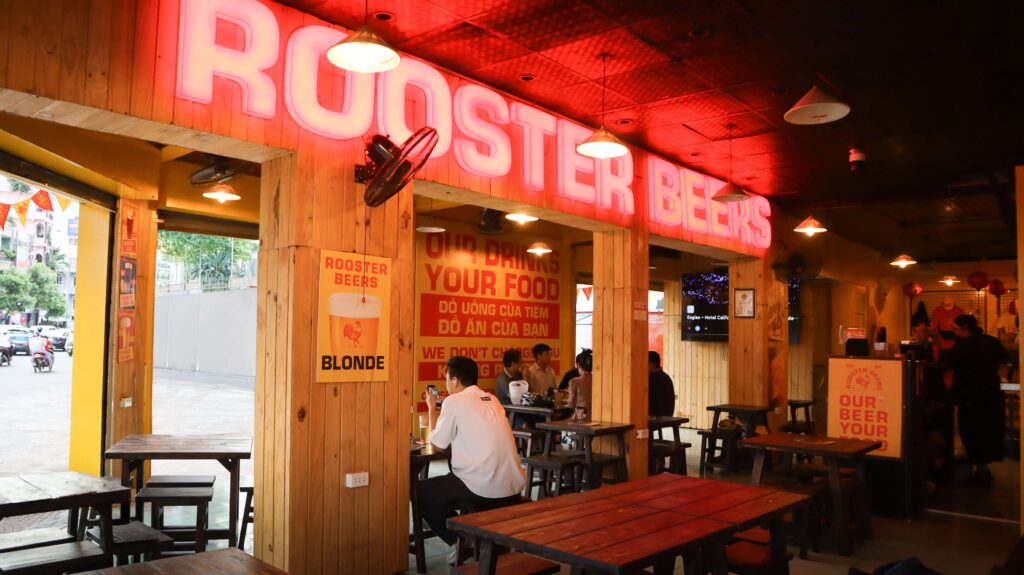
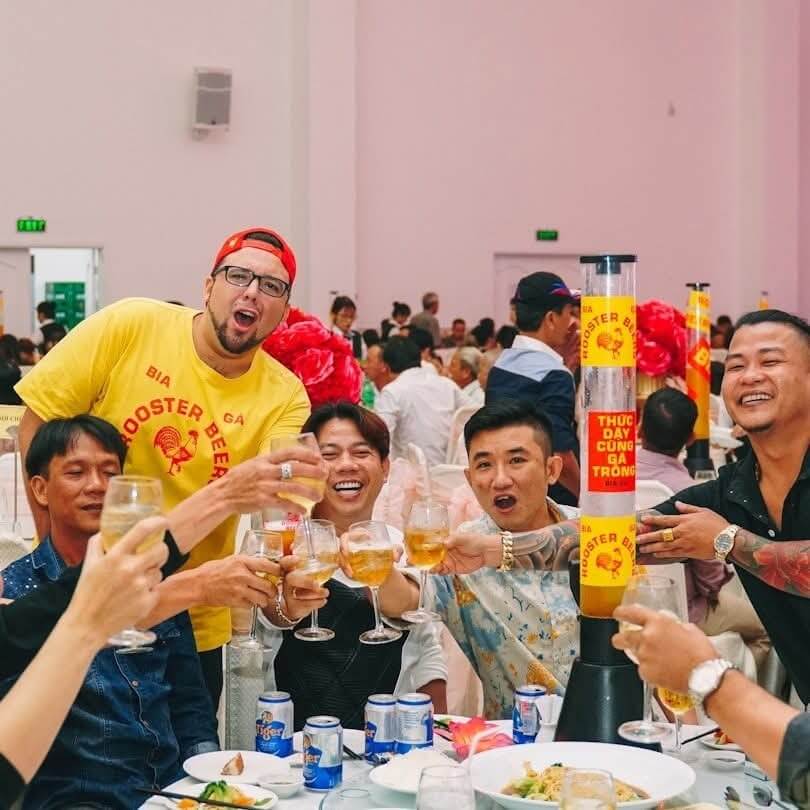
These days, having multiple taprooms obviously helps with visibility and walk-ins, but the acquisition engine is still mostly grassroots: sponsorships, events, memorable POSM, and organic word of mouth, which is still the best channel we have. Tiệm Bia Gà also has a built-in hook, we don’t run kitchens. Our whole pitch is “our drinks, your food,” so guests bring food from home or order in from a neighboring spot, which is honestly one of my favorite parts of how our taprooms work. We’re not out here trying to compete with the mom-and-pop shops around us, the snail spots, the street food carts, the family-run kitchens on the corner. Instead, we bring their menus right into our taprooms so our guests can order straight from them. We put our money where our mouth is when it comes to community, we’d rather build the neighborhood up around us than try to replace it. At the end of the day, it keeps us lean, and it’s become part of our identity.
Why no kitchen? That’s the number one question I get asked, all the time. There are a handful of reasons. The lowest-hanging fruit is overhead, no kitchen means no food licensing, no additional staff training, none of the operational weight a restaurant carries.
Then there’s the identity problem. I can’t tell you how many breweries I’ve visited with a terrible Google rating because their truffle fries came out cold, even though the beer scored a 5 out of 5. The whole brewery suffers for it. What I’ve seen happen to breweries everywhere, Vietnam, the US, Singapore, doesn’t matter, is that food creeps in, takes center stage, and the beer, the actual reason the place exists, ends up sitting in the back of the room. Most of these places quietly turn into restaurant companies and stop being breweries. We cut that out entirely so the focus stays only on the beer.
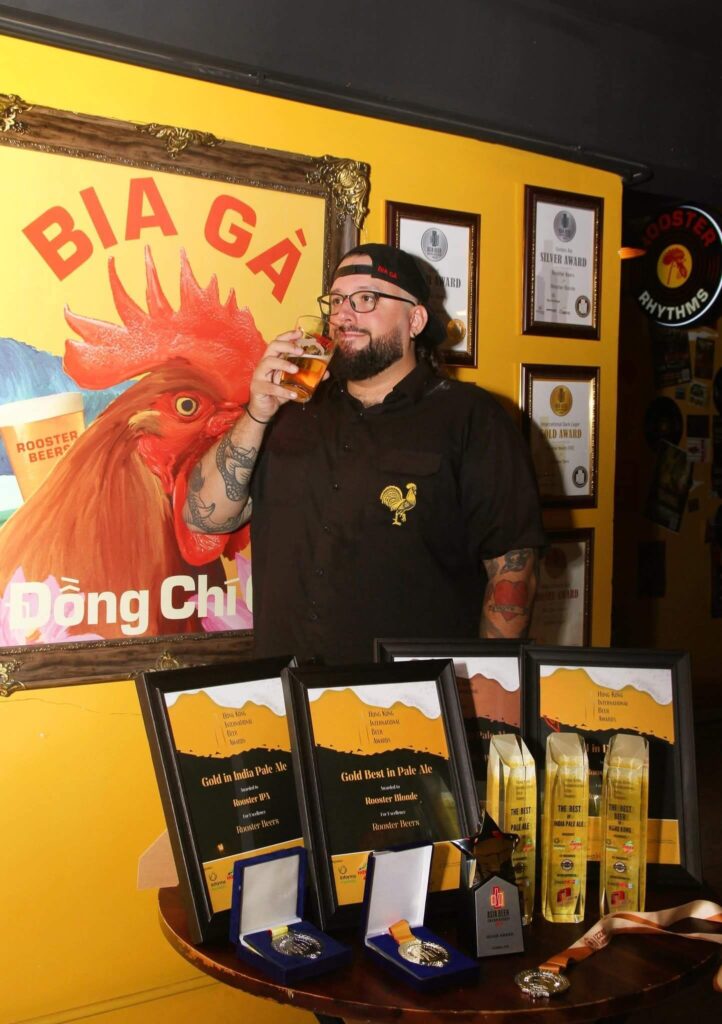
Since we don’t have a kitchen, opening a Tiệm Bia Gà means making sure we’re surrounded by local food shops, and we extend an open invitation to our neighbors to sell through us. We don’t charge our community members or our customers a cent for it. When we open a new location, we walk the block, let shop owners know we don’t serve food, and ask them to drop off a menu for our guests to order from. It’s usually met with a suspicious look and a “what’s the catch” conversation, but once they hear there’s no charge and all they have to do is handle their own orders start to finish, they’re in. My favorite example: when we opened our District 10 location, a woman three doors down came in asking if she could sell her chicken and rice to our guests. We said sure. Years later, after we picked up some awards, I went back to celebrate and she was still there, same spot, except now with a much bigger menu than just chicken and rice. Getting to watch that kind of community growth happen firsthand is one of my favorite parts of this job and this model.
People push back and say you can’t retain guests without food. That’s true and false at the same time, and we’ve spent years proving it. On the “won’t stay long” side: this model runs on volume, and food takes up stomach space that would otherwise go to beer. I’ve actually tested this with a friend’s food cart parked at one of our taprooms, liquid sales dropped when food was available. On retention: our taprooms have become the “before” and “after” for our guests, people gather with us before heading to dinner or an event, then wind down with us afterward. I like that we’re not chasing one table trying to hit a big ticket, we’re turning tables over and hitting volume, and every new face through the door is another person interacting with the brand.
I can’t give you specifics on build cost or payback period, sorry! What I can tell you directionally: the venue size we typically use in Vietnam is about the size of a converted house, the kind of space you’d see turned into a cafe, a bubble tea shop, or a small restaurant. Fitting one out usually lands at or under $15k USD. Funny enough, from my own experience and friends who’ve opened venues here, paint is usually the single biggest cost when you’re branding a space properly.
Competition
Before I get into this, I’ll say up front this is purely my own view of Vietnam’s craft beer market, not some objective ranking.
Vietnam’s craft beer scene has grown a lot, especially post-COVID, and honestly the quality across the board has gotten way better compared to before the pandemic. It’s also seen its share of closures along the way, but the ones still standing have really upped their game. There’s also been a wave of newer, younger local breweries popping up recently, names like Ghost Ship among others, which is exciting to see.
It’s hard to point to a direct analog for our taproom model specifically, since we don’t run a kitchen and, as far as I know, every other brewery here with a taproom does. But in terms of who’s actually making craft beer here, I’d break the scene down into a rough scale I put together earlier this year (there’s a ton more of us out there, just naming a handful for this bit, no hard feelings if I miss you):
Traditional Craft: drinkability first, not overly hopped or loaded with fruit additions. That’s us, alongside Platinum Beer, Fuzzy Logic, 5 Elements, and Bia Nha.
Modern Craft: traditional recipes with a niche craft twist layered in. Deme Brewing, Belgo, East West, Steersman, Te Te.
Progressive Craft: pushing the actual limits of what craft beer can be. Heart of Darkness, Turtle Lake, 7 Bridges, and others in that space.
These aren’t just style labels to me, they map to real differences in who’s actually drinking what. Someone who regularly drinks Belgo Blonde generally isn’t reaching for a Heart of Darkness NEIPA, and vice versa. That’s why I keep modern and progressive as separate tiers instead of folding them together, even though from a purely technical, beer-nerd lens they can look closer than they feel to a local drinker here.
Within our own lane, our moat isn’t the beer style, plenty of people make good traditional craft
beer here. It’s the model around it. No kitchen means lower overhead and a taproom that’s easier to run at volume. We’re priced to be a regular habit, not an occasional treat. And we’re built for the Vietnamese market first, in language, in branding, in where we open taprooms, instead of chasing the expat crowd like most of the scene has. That combination, accessible price, no-kitchen model, hyperlocal focus, is hard to copy without rebuilding the business from scratch.
Tiệm Bia Gà is built to be your local hangout, not a place dropping wild new releases every week. We do seasonals and small-batch runs, but the core idea was always to strip away the notion that craft beer is a Western thing priced out of a local salary.
Rooster’s been labeled “entry-level” craft beer for years, and that’s exactly where you want to sit in a market that’s still learning the what and why of craft beer. That positioning is exactly why someone who’s never had a craft beer in their life finds it a lot easier to walk into a Tiệm Bia Gà than into a spot selling itself as a full-blown “craft beer experience.” There’s less intimidation, less pretension, and it doesn’t require you to already know anything going in.
Design plays a real part in that too. When we went through a rebrand with Rice Creative (now BaseSGN), the team did a fantastic job making the brand feel approachable and relatable to the local identity, not just the logo and packaging, but how that carries into the taproom itself. Put everything we’ve built over the years together, the pricing, the no-kitchen model, the branding, and it adds up to a taproom experience that feels like it belongs in the neighborhood instead of asking people to rise up to meet it.
The lower price point (27.5k at the time of writing) wasn’t pulled off a competitor’s price list, it was set as a loss leader. Like I mentioned earlier, the whole idea was to strip away the notion that craft beer is a Western thing that’s expensive and confusing. That came out of real conversations with local friends, a few surveys, and a focus group we ran, which all pointed to the same thing: craft beer here was seen as foreign, pricey, and unclear. So we built a beer and priced it at 22k to kill that perception outright. It wasn’t benchmarked precisely against Saigon Special or against other craft brands, it was benchmarked against the story people already had in their heads about what craft beer costs and who it’s for.
Guests in the neighborhoods we opened in would see 22k on the board, get curious, come in, try it, have a few, and then start asking what else we made. That’s the moment it clicked, they’d move on to Rooster Blonde, Pale, IPA, even the Double IPA. Getting someone who’s only ever had Saigon Special to try a Rooster at 22k is a completely different ask than getting them to try one at 80k somewhere else, the price removes the risk from the decision entirely.
From there, it’s usually about three visits before someone becomes a regular. The first is curiosity. The second is bringing a friend back to show off what they found. The third is showing up with a whole table, usually with their own food or something ordered from a favorite spot down the road.
As for pressure to raise prices, we’ve managed that expectation over the years, mainly because our taprooms only pour our own beer, so we’re the ones who control that number. We have had other venues that carry Rooster complain our taproom price undercuts them, but when you point out they’re selling mass-market commercial beer for two to four times what the local nhau spots charge, it clicks: it’s not about the price, it’s about the brand, and people will pay for it either way. Our taprooms aren’t really built to turn cash over fist, they act more like cost-efficient billboards for the brand.
Lessons Learned
The biggest thing I’ve learned is that having worked nearly every role in this business, technician, sales, marketing, commercial leadership, operations, all the way to running the company, gives you something you can’t fake as a leader: firsthand understanding of what each part of the operation actually requires. When you’ve done the job yourself, you lead differently. You know what’s realistic to ask of people, and you know where the real friction points are instead of guessing from a spreadsheet.
My life has changed for the better since starting this journey, that’s for sure, though I don’t even know where to start. Most recently, my wife and I welcomed our daughter into the world, which has been the biggest change by far.
If it wasn’t for this journey in Vietnam, I would’ve never met my wife, Carmen, who’s from South Africa. We met through the work itself, out visiting a bar one night. I learned through endless site visits, line cleanings, and sales meetings that what starts as a conversation can turn into years of friendship. I was doing exactly what the job demanded: showing up late, showing up early, being wherever the business needed me. I have many friendships I still cherish to this day that all happened because of this business.
That grind taught me a level of responsibility I didn’t have back home. I was pulling my own weight, and then some, for years. I remember getting on my scooter at 10pm and driving 30 minutes across town because a venue forgot to turn on the CO2 and couldn’t figure out why their tap wouldn’t pour. Nights like that were normal for a long stretch, and they shaped who I am now, not just as someone running a company, but as a partner and a father.
Tools
It depends on which part of the company you’re talking about, we run a handful of different programs depending on the function.
Sales and distribution runs on a CRM called GetFly.
The brewery runs on an application called Beer30, which tracks raw materials, packaging materials, what’s currently brewing, recipes, basically everything on the production side.
Taprooms run on iPOS, which handles store-to-store inventory, SOPs, and ordering.
Everything else across the company runs on the usual suspects, Google Docs, Sheets, and the
rest of that ecosystem.
Resources
I’ve had three great mentors who really shaped who I am: Michael Sakkers, Ian McNeilage, and Thanh Charles. Each one taught me something about being creative, being business minded, thinking outside the norms, and just plain hard work.
Outside of that, I do have a stack of business books, but I use them as resources rather than something I identify with or build a personality around. Same with podcasts, I’m not out here chasing a show that’s supposed to change my life. If anything, cookbooks do more for me, flipping through recipes keeps me creative and my mind sharp, and half the time I end up working through actual business decisions while I’m cooking.
Advice For Founders
Do it. Taking that leap has been the best move I’ve ever made, professionally and personally. I wouldn’t have this life if I hadn’t jumped into the unknown back in 2016 with basically nothing to fall back on.
That said, do your homework on the type of business you actually want to build, here in Vietnam or anywhere abroad. The market, the regulations, the culture, all of it works differently than what you’re used to, and it’ll bite you if you go in blind. Reach out to people already living it. Most of us who’ve been overseas a while are on LinkedIn and more willing to talk than people expect.
But if you’re on the fence: take the leap. It’s worth it.
What’s Next
What’s next for us at Rooster Beverages? More of the same, just bigger. We’re looking at more taprooms, new regions, and new products!
For me personally, though, I’m looking toward my own next chapter. I’m ready to be creative and build something new. After spending almost a decade building Rooster, it feels like the right time to move on. I’ll take my own advice here and take another leap into something new, maybe that’s building my own thing, or maybe it’s helping one of you reading this. Cheers!
Where To Find Them
Email: Viteri.Don@gmail.com
LinkedIn: https://www.linkedin.com/in/don-viteri-vn/
Rooster Beverages: https://roosterbeverages.com/en/home/
Rooster Beers: http://roosterbeers.com/
Rooster Beers “Tiệm Bia Gà” Taprooms: http://roosterbeers.com/taprooms/